Pages

  • RSS
Showing posts with label SOP. Show all posts

Sunday, May 29, 2011

Success Team ~ Week Two

A simple three item list turns into the most genealogically productive week I've had in months. Why? Because I'm accountable to my team.

I could have spent hours contributing to Find A Grave, but I had already reached my goal and earned my check mark, and I had to move on to the other items on my list. Why? Because I'm accountable to my team.

Could I have accomplished as much without Jenny? M a y b e. Would it have been anywhere near as much fun? No way.

One of my goals last week was to ask the Cincinnati Library for copies of announcements from an archived German newspaper. I've wanted to do this forever, but it kept getting bumped by other tasks. This time it was a Success Team goal, so I had to check this item off my list. And because I'm accountable to my team, I now have this:
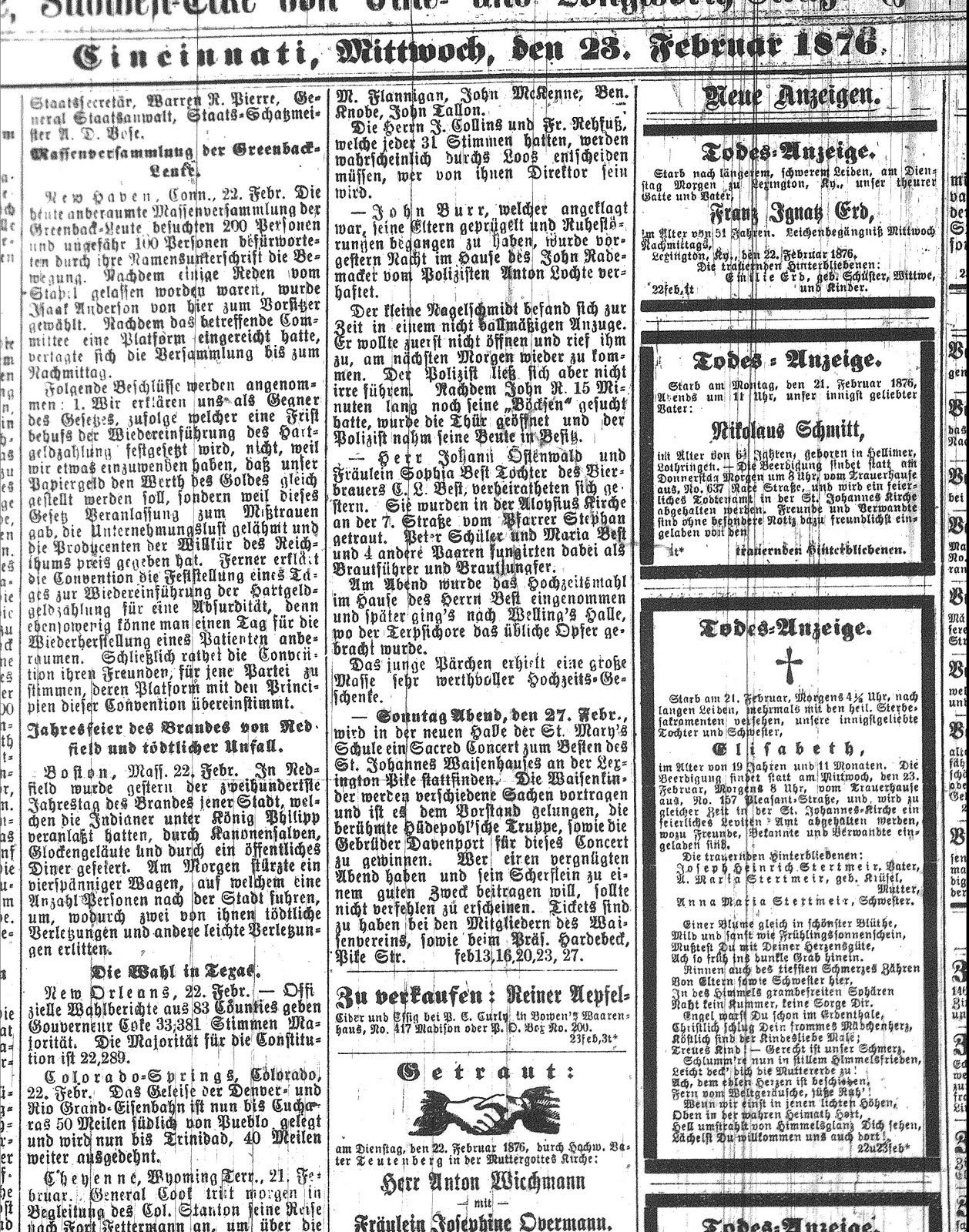

It's an obituary from February 1876 for Nicolaus Schmitt, my third great-grandfather! I learned his date of death. I verified an address I'd been following in city directories for years. I saw evidence of a relationship with his children. All because I was accountable to my team.

Checking in once a week, sharing our triumphs and failures, getting an Atta Girl or suggestions for another route, plotting next steps; it's all part of a collaboration that cannot be beat.

GO TEAM!!  

Friday, May 20, 2011

Genealogist or Family History Researcher?

What do each of these terms mean to you? Which term do you use when describing yourself?

To me, a genealogist is a little more devoted to the system and the rules, perhaps a tad better organized, maybe less likely to bark up the wrong family tree.

A family history researcher may or may not do all of the above, but also spends a fair amount of time exploring paths that, to the casual observer, may seem unrelated to documenting one's lineage.

Because of my diverse ethnic background, I find myself meandering back and forth between both worlds.

My Swedish Tolfs are unique in their homeland. If you're a Tolf, we are definately related. My interest in this line includes causes of death ~ they repeat themselves every two or three generations all the way to the present. I've gotten fairly good at deciphering medical records.

There is alot of emotional baggage in the Mueller line. Deaths, divorces, remarriages, and stubborn personalities are forever simmering over a low heat. Who can answer this question or that without causing the pot to boil over? There are many mysteries to solve in the US before I can cross the ocean to Switzerland and begin the Swiss records learning curve.

Clarkes and Littrells require a history lesson with every record; what Revolutionary or Civil War battle took place where? When did the city/county/state boundaries change? Which reformed church had a pastor during this or that timeframe? What on earth is a Dunkard? And will I ever find the answer to the #1 burning question ~ what is their country of origin?

The Schmitts are from France and their surname is hardly unique. I require three forms of ID when working with their records. It would be easy to follow the wrong Schmitt, especially one named Jean, Jules, or Nicolas as they appear in every sibling's family. Then there is the Alsace-Lorraine issue, a region that changed hands many times. I use research logs liberally with this branch and backtrack to double-check my work with each new discovery.

My Manx ancestors had a preference for a limited number of given names. There is a William and a John, sometimes two or three in every family. The Isle of Man has it's own government, but is culturally influenced by Ireland, Scotland, Wales and the UK. Records are well kept, but can be challenging to locate. The only other known family member researching this line recently passed away. Playing alone in dusty libraries isn't nearly as much fun.

I enjoy discovering the story that unfolds with each new record. Storytelling helps engage disinterested family members. The charts are wonderful for placing people visually, but the stories make the names on the chart memorable. Making my ancestors memorable for future generations is one of my top ten reasons for being a genealogist. And a family history researcher.

Saturday, April 23, 2011

Genealogy Success Team Wanted

I'm stuck. And I need your help.

This year my family history progress is pitiful and its nearly May. There is much more I'd like to accomplish, but I just can't seem to do it alone.

When I was a young entrepreneur, I met with three people once a week for an hour. We gave each other 15 minutes; five to review, five to brainstorm, and five to set new goals.

We were accountable to each other. We guided each other over bumpy roads, cheered each other on, and forced each other to acknowledge and overcome perceived shortcomings.

I need a new virtual success team focused on family history. Are you interested? Here's what you'd have to do:
  • Be committed. Once you join, you must attend 95% of meetings.
  • Be prepared to share your accomplishments or lack thereof with three other researchers.
  • Be receptive to suggestions and generous with suggestions for others.
  • Be sensitive to the privacy of your team members.
  • Be prepared, organized, brief, and focused during each meeting.
If you are passionate about your family history but making less progress than you'd like, please consider becoming a member of my Success Team.

Tuesday, December 28, 2010

Standard Operating Procedure

The files stored between my ears are sometimes less than accessible. Whether you call them senior moments or information overload, they have the potential to thwart my efforts at organized research. Hence my SOP:

Active surnames have a hanging file with the surname on the label in all CAPS. Active direct line surnames also have yellow file folders labeled as follows:
  • Census Records/City Directories
  • Charts and Trees
  • Correspondence
  • Multiple Births, Marriages, Deaths
  • Photographs
  • Requires Further Action
Documents in the Census Records/City Directories folder are placed with census in the front and city directories in back. Each group is arranged in reverse chronological order; i.e. most current in front.

Use the same system in the Charts and Trees folder; charts in front, trees in back. Arrange each group in reverse chronological order.

File Correspondence in reverse chronological order.

The Multiple Births, Marriages, Deaths folder consists of four groups; births, marriages, deaths, and misc. Each group is in reverse chronological order.

Label and scan pictures to appropriate computer files, FTM, and Ancestry.com. Store originals in archival-quality containers. Arrange copies by ancestors' given names and store in Photographs.

Arrange the items in the Requires Further Action folder in order of priority. Highest priority items are in the front, lower priority items behind.

Type file folder labels in 14pt Arial font. Surnames are in CAPS on the top line, then space, hyphen, space, and year of birth. Given names are in upper and lower case on the second line. Highlight given names in yellow on direct line ancestors’ file folder labels.

Each direct line ancestor has a manila file folder containing a current Family Group Sheet and documents that are exclusive to him/her. These documents are arranged in reverse chronological order. Working copies of active family group sheets are in my genealogy brief case, filed under the appropriate surname.

Collateral ancestors have a kinship report in the front of their folder listing immediate family members.

File a copy of each marriage record in both spouses’ folders.

Documentation for children is filed in their father’s folder (in birth order) unless a.) the quantity is such that a separate folder is necessary for the child or b.) the father is unknown. In the latter case, file documentation in the mother’s folder.

For each direct line ancestor; locate, secure documentation, and cite sources for at least the:
  • date and place of birth
  • date and place of baptism and/or confirmation
  • date and place of marriage and/or divorce
  • date and method of immigration (when applicable); naturalization records
  • residences (census records, city directories, tax records)
  • land ownership, mortgages, deeds
  • cause, date and place of death
  • wills when available
  • date and place of burial and photo of headstone when possible
Create a timeline for each family group; include political leaders and world events during the ancestor’s lifetime.

Create maps with residences and their proximity to local churches, schools etc.

Log this info in the facts section of Family Tree Maker. Cite sources and add any additional information to the Notes section.

Update the public tree on Ancestry. Update the LITPL web site. Update Find A Grave. Post new info on Twitter and Facebook.

Keep my fingers crossed that someone researching the same line finds me.

Saturday, April 17, 2010

Spring Cleaning Genealogy Style

In the spring, life is all about cleaning and organizing inside and out. I'm fairly organized (obsessive according to my family, but I digress), so restoring order has never required a huge amount of time or energy. Until I turn to my genealogy files.

Every piece of paper left unattended seems to multiple overnight. I used to awaken to an unruly stack of folders, forms, and files; the result of overzealous family history searches.

One day I had an epiphany. I needed a SOP for my hobby, something similar to what I had at work. And my genealogy took a turn for the better, both historically and environmentally.

To be effective, a Standard Operating Procedure has to be written. I appreciate good documentation since my aging brain cells can misplace even the most brilliant of ideas.

So I created a Word document that clearly spells out how I do things. Things like who gets a manila folder and how those folders are labeled. My SOP explains how a surname is determined to be worthy of its own hanging folder. Where unmarried daughters' records will be kept. How to tell (at a glance) the difference between three folders with the same first and last names on the labels. What each direct line folder should contain. The purpose of those color-coded folders in the front of each hanging file.

One of the reasons I documented my process was the gap between research opportunities. If too much time lapsed, I wouldn't remember where I had left off. My SOP is priceless for that alone, but even more so in many other ways:

* Who will take over my research? If they can't understand my system, what precious records will they toss?

* Fewer trees give their lives to the creation of census records printed two and three times because I didn't know I already had them. My SOP explains where one copy will be kept for each family group. Don't have the SOP handy? Not to worry. Part of the instructions are to put directions for shared records in each folder.

* Only a tiny increment of time to play genealogy? Each folder has complete information and 'next steps' are clearly explained.

It's quite possible that your system is better than mine. That's okay. Having a system is the real key. Consistently using that system is a time-honored method for unlocking more priceless family history treasures.