Pages

  • RSS
Showing posts with label organizing. Show all posts

Monday, January 30, 2012

Resolutions Revisited

Thank you Stephanie for encouraging New-Year-Resolution-setting-bloggers to post goal updates once a month. Great idea! Could be just the push I need to stay on track; although my geneabuddy does a pretty good job of that too!

I only set six resolutions this year. In January I gathered files and folders from (too many) file cabinets, paper stacks and file boxes. I established one place for the documents associated with those all-important 12 surnames. I worked my way through the mess collection of paper in the Clarin and Clarke folders. That helped with this goal:

2.) Focus my research on 12 direct-line surnames...Start by organizing the surname-related computer files, manila folders, family group sheets, and pages on my web site.

My new-and-improved filing system includes folders labeled "Requires Further Action" for each surname. I found the coolest colored folders with graph paper-fronts and backs. Once the contents of the folder are prioritized, I can use the graph paper to create an index/to-do list so next-steps are easy to determine.

I worked on my web site, adding a page for Bidenharn and updating pages for Clarin, Clarke and William Penrod Clarke, Landstrom and Johan Peter Landstrom, Mangels and Gustave Robert Mangels, Peterson, Thompson and Peter Thompson, and Walton. That addressed goal #2 above and this goal:

4.) Keep other living descendants up to date on our family history research progress through emails, letters, Twitter, this blog and my web site. Search for as-yet-unknown cousins in the same way.

In January I devoted quite a bit of time to this goal:

5.) Honor the relationship between genealogy and scrapbooking: Scan and digitize old photos. Preserve hard copies of pictures. Archive online photos off-site. Organize, label and safely store slides and negatives. Share pictures with relatives. Assemble heirloom photo albums.

I've fallen in love with Picasa. It's free and easy to use. I have a million photos to scan and Picasa makes the save, edit, categorize and file steps fast and easy. I averaged 150 scans a week in January and stored the originals chronologically in archival-safe containers. There are still a million minus 600 photos left to scan, but I'm making progress!

Thanks again Stephanie for encouraging me to revisit my goals, check my progress and set my sights on February!

Monday, October 17, 2011

Family History Spreadsheets

To know me is to know my love of all things Excel. I can create a spreadsheet faster than you can say the word formula. I use Excel for everything at home and at work, and of course, in my family history research.

A color-coded spreadsheet is the easiest way for me to stay organized while I play genealogy. I keep one in the front of each surname folder to give me a hint where I left off help me track what I know and how I know it.

This spreadsheet provides a location for each family member at a given point in time, a list of sources I may want to check, and the places I need to record my newly-found data. It's my go-to checklist and I Excel at using it.

What's your favorite genealogy organizing tool?

Wednesday, September 21, 2011

FGS 2011 ~ The How

How does one prepare for an annual genealogy event that lasts for several days?

I brought some unnecessary items along to Springfield and learned a few important lessons. One was that my arms get tired carrying all that stuff! So for the next genealogy conference, here's what I'll take:

Backpack: Hands-free carryall*. I was forever setting my briefcase down and picking it up again, particularly in the vendor area. A backpack could have been slung over one shoulder allowing me to keep my things close without the risk of leaving them behind. Sure would have made shopping easier!

Clothing: Lots of layer options. Some rooms are warm, some are cool. Crowding makes a difference, so the room that starts out too cool can quickly become too warm as seats are filled. Lightweight sweaters and wraps over short sleeves worked best for me.

Liquids. You will need water. Conference coordinators had water available in the main hall between programs which was very thoughtful. But I was still quite parched by the end of each 10 hour day. Next time I'll bring an easy-to-refill easy-to-identify-as-mine container in my backpack.

Drugs: Think mini personal pharmacy. There isn't a CVS in the conference center. If you have ever experienced allergies, colds, headaches, or papercuts; plan and pack accordingly.

Files: Less of them. Paper copies of family group sheets times 16 ancestral lines are cumbersome. Without a laptop I felt I had to bring photocopies, but I didn't have the time (or the need) to look at them. Even if I had researched more in Springfield, I could have carried less than I did.

Handouts: Group them per workshop. One of the things I did right was planning my classes ahead of time and stapling the pages for each of those workshops separately. I carried one day's worth at a time. Easy peasy. I did change my mind on one track, and managed just fine without the handouts.

Research questions. Have them prepared before you arrive. This isn't to say you won't think of new questions while you're at the conference; you will. But a post-it note on my stapled handouts reminded me to listen for a specific resource or repository that would impact one of my brick wall ancestors.

Notetaking: Use a composition book. I'm so glad I thought of this for the Springfield trip! The hard cover gave me a writing surface in crowded rooms. My notes are in the order of the programs I attended. The people I want to connect with are listed with the class in which I met them. Brilliant!

*I saw people with carry-ons on wheels in the conference area. I would not recommend these. The area was crowded with more than 2000 people who were looking straight ahead, not down at the floor. The people pulling these bags didn't see all the near-collisions left in their wake.

What do you bring to genealogy conferences? Have you ever brought something you wished you hadn't? What will you do differently next time?

Monday, September 19, 2011

Genealogy Success Team Update

I've made more progress on my family tree since Jenny and I started our Success Team than I'd made in the six preceding months combined. It has to do with accountability. I don't want to waste Jenny's time by telling her I couldn't finish the goals I set during our last meeting, so I get them done. Thanks Jenny, and go team!

Working toward accomplishing my 2011 New Year's Resolutions, I have a five-pronged approach to each week. This week my list consists of:

BLOG: Follow Lisa Alzo's 15-minutes a day plan. I missed Lisa's program at FGS 2011, but read about it on Diana's blog post. Like Diana, I'm pretty busy. But as Diana mentioned, I'm sure we can all squeeze in 15 minutes a day to do something more important than reading Facebook status updates.

LEARN: In a never-ending quest to add to my overall genealogical education, this week I'm going to finish reading one of the books I bought at FGS 2011; "Finding Your Chicago Ancestors; A Beginner's Guide to Family History in the City and Cook County" by Grace DuMelle. I'm not a beginner to research in this area, but the book has more than beginner information. I've already found several new resources.

ORGANIZE: What genealogist doesn't need to be better organized? I recently created an "at-a-glance record inventory" in Excel. This week I will add comments to the Mueller page.

You probably know about the yearbook collection on Ancestry. I'm interested in Englewood High School. The oldest yearbook on Ancestry for that school is 1940, far later than I need. A Google search shows records for EHS at the Harold Washington Library in Chicago. Time to start a list for a road trip.

PRESERVE: I'm a huge fan of Find A Grave. This week I want to make 15 new contributions. I also need to upload another CD of family photos for my scrapbook project.

RESEARCH: Ah yes, the real reason I play the genealogy game! This week I hope to locate the church my Mueller/Schmitt family attended in Chicago and request records from them. I'd like to answer several questions:
  • In which Swiss village was Jacob Mueller born?
  • When did he immigrate to the United States?
  • Did Elise have four children with Jacob or only two?
  • Is there a record of (Elise's son) Otto's divorce? Of his suicide?
  • Where did (Jacob/Elise's daughter) Alma live after Jacob died?
  • What happened to Alma after (her stepbrother) Otto' death?
My French translation comfort level is decreasing. I've been away from the records for too long. So my last task for this week is to transcribe and translate at least one French vital record for an ancestor in Moselle.

This should be a fun (and productive!) week for genealogy. What's in your wallet on your genealogy to-do list?

Saturday, August 27, 2011

Success Team Update

For the past few months my Saturday morning routine has included a hot cup of coffee and a spicy genealogical chat with Jenny.

Jenny is vacationing, so (sigh) I'm on my own today. We worked hard on our lists last Saturday knowing we would have two weeks to complete them. These were my goals:

BLOG: Create one A Child Lost and one F.A.G. blog post. Catch up blog reading.

I chose my next Child Lost and put a rough draft together. I posted about my experience at Darien Cemetery here. And I've been diligently reading all the fun and interesting and educational blogs I follow. I am caught up! [on target]

LEARN: Review FGS classes and write rough draft questions. Read The Twitter Book by Tim O’ Reilly and Sarah Milstein.

Not only did I review the classes, I downloaded my syllabus and bound it for travel - yay me! I changed a class too, substituting Twitter for the 1940 census. I'll start writing the rough draft questions this weekend. I continue to read The Twitter Book in my "spare" time. It's a great read and has already changed the way I use Twitter. [on target]

ORGANIZE: Clean up the Mueller hanging file. Create checklists for each document type encountered.

Good gravy, what a mess! As you can see in the photo below, I sorted all the papers so I can work on like-items. I created a spreadsheet (are you laughing Jenny?) for the document types. [on target]

PRESERVE: Verify that all direct line ancestors appear on F.A.G. If photos exist, add them. Sponsor Daddy and Harold Mueller. Add the EASY photos from Darien Cemetery.

Hmm. I may have to pick up the pace on this task. I haven't checked for all my ancestors. [behind schedule] I sponsored my dad's memorial, but decided against sponsoring his dad's for the time being. [check] I'm about a quarter of the way through the photos from Darien Wisconsin. [behind schedule - eek]

RESEARCH: Look for Jacob’s confirmation record on the Swiss film at the FHC. Add specific genealogy searches to eBay.

Thursday evening I looked through the entire film hoping to find a birth, baptism, or confirmation record for Jacob. No luck. But, as you may recall, this was a long shot. My surname-related searches are now on eBay. [check]

That makes an un-terrific mix of "on target", "check" and "behind schedule". Maybe a B- for the week so far? I'd better quit chatting and get back to work!

Tuesday, August 16, 2011

Those Old Photographs


First Grandchild's First Christmas

I know the little girl in this picture. I catch a glimpse of her every time I look in a mirror.

The hand in the upper right-hand corner belongs to my Grandpa John. I'm sure his unlit cigar is in his left hand; it always was. Makes me smile just remembering.

But who is the woman on the left? I'm pretty sure it's Judith, my great-grandfather's second wife.

Shall I assume I'm correct? There isn't anyone left to ask. Or should I mark the picture with "my guess is..."?

My family looks at me a little strange when I label my photos with:
  • the date of the event
  • a description of the occasion (so-and-so's birthday for example)
  • location in which the picture was taken (address-specific)
  • all participants' first and last names; and age when appropriate
  • all participants' relationships to one another
Okay, maybe that's excessive. But it sure would have been nice if someone had labeled this picture with more than "First Grandchild's First Christmas".

Monday, July 18, 2011

Success Team Update - Technically Week 9

Last week was rough for Jenny and me. Work was busy, family had issues, weather was yucky. Hey, some weeks are like that.

So we made liberal use of the word "technically" during our virtual meeting Saturday morning.

Last week I found 30 pieces of paper while filing that were either filed the "old" way or not at all. I said I was going to start processing them. You know, make sure they are in Family Tree Maker, on Ancestry, on Find A Grave... that kinda stuff.

Technically I did start processing them, but made little progress. When I found information missing from these documents, I did more research. This turned 30 pieces of paper into 52. Jenny referred to the original bunch as 30 cups of quicksand. The more I flailed about, the deeper I sank. Ugh. But technically, I was only supposed to start processing them. So I get a sorta checkmark.

Technically Jenny got some sorta checkmarks too. It was a tough week, remember?

We each reduced our expectations for the upcoming week. Three tasks each.

In my case, I am to finish a task I already started, post information I already acquired, and tell you about an experience I already had. Way to lower the bar!

I'm okay with that. 'Cause technically we are still moving forward on our respective family history research. And that's the reason I love this team.

Saturday, July 2, 2011

Playing Ketchup by Myself

When did I become so disorganized? Is it an age-related issue? A busier-than-ever conundrum? Or am I simply working on too many projects at once?

Here's a perfect example. One of the items on my Success Team to-do list is to create a rough draft list of the ancestors I know are buried in Oakwoods Cemetery. Seems pretty straightforward, doesn't it? And I know it will be easy because when I enter places of burial in Family Tree Maker, I put the cemetery name, address, and phone number in the place field.

So I confidently open FTM, click on Places and scroll to Oakwoods. Nine names are listed. Seven of them have dates of burial. Both of the names missing the burial date are collateral ancestors. To my credit they each have a date of death gleaned from their obituaries. Sounds like a check mark looms in my future, doesn't it?

Then I look closer at the names on my list. Conspicuously absent is my second great-grandfather Jacob K. Mueller. I know he is buried at Oakwoods because I have a copy of his obituary and his death certificate.


Of course these documents would be attached to Jacob on Family Tree Maker and Ancestry.com, right? Not so much, no.

But that shouldn't be a problem. I can simply click on My Pictures and add the images to Jacob's file. My Pictures has a Family Tree folder inside with a Mueller folder inside that. The Mueller folder contains 19 objects, none of which is Jacob's death certificate. Drat.

Oh, I remember now! I changed the way I label my photo files. I'll have to look in the "old" Family Tree picture folder and then the Mueller file there.

57 objects are patiently waiting inside this folder. Thankfully Jacob's death certificate is here. Named DC Jacob K Mueller.pdf. And here, named DCJacobKMueller.pdf. And here again, this time named Jacob Mueller DC.jpg.

I think what happened was...well...you know...I'm really not sure what happened. But it looks like I already have a goal for the July 9th Success Team meeting. Does this make me an overachiever?

Sunday, May 29, 2011

Success Team ~ Week Two

A simple three item list turns into the most genealogically productive week I've had in months. Why? Because I'm accountable to my team.

I could have spent hours contributing to Find A Grave, but I had already reached my goal and earned my check mark, and I had to move on to the other items on my list. Why? Because I'm accountable to my team.

Could I have accomplished as much without Jenny? M a y b e. Would it have been anywhere near as much fun? No way.

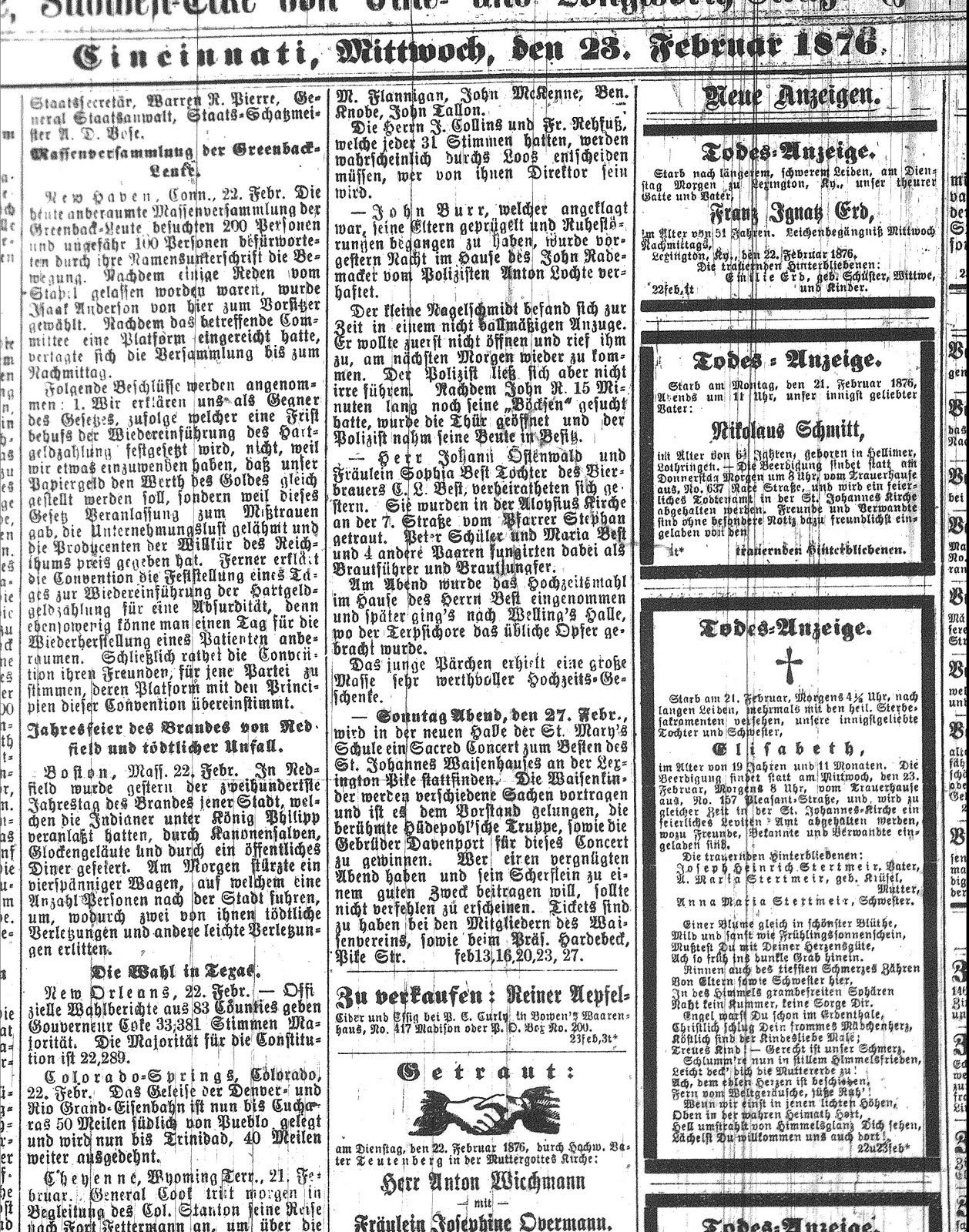
One of my goals last week was to ask the Cincinnati Library for copies of announcements from an archived German newspaper. I've wanted to do this forever, but it kept getting bumped by other tasks. This time it was a Success Team goal, so I had to check this item off my list. And because I'm accountable to my team, I now have this:


It's an obituary from February 1876 for Nicolaus Schmitt, my third great-grandfather! I learned his date of death. I verified an address I'd been following in city directories for years. I saw evidence of a relationship with his children. All because I was accountable to my team.

Checking in once a week, sharing our triumphs and failures, getting an Atta Girl or suggestions for another route, plotting next steps; it's all part of a collaboration that cannot be beat.

GO TEAM!!  

Friday, May 20, 2011

Genealogist or Family History Researcher?

What do each of these terms mean to you? Which term do you use when describing yourself?

To me, a genealogist is a little more devoted to the system and the rules, perhaps a tad better organized, maybe less likely to bark up the wrong family tree.

A family history researcher may or may not do all of the above, but also spends a fair amount of time exploring paths that, to the casual observer, may seem unrelated to documenting one's lineage.

Because of my diverse ethnic background, I find myself meandering back and forth between both worlds.

My Swedish Tolfs are unique in their homeland. If you're a Tolf, we are definately related. My interest in this line includes causes of death ~ they repeat themselves every two or three generations all the way to the present. I've gotten fairly good at deciphering medical records.

There is alot of emotional baggage in the Mueller line. Deaths, divorces, remarriages, and stubborn personalities are forever simmering over a low heat. Who can answer this question or that without causing the pot to boil over? There are many mysteries to solve in the US before I can cross the ocean to Switzerland and begin the Swiss records learning curve.

Clarkes and Littrells require a history lesson with every record; what Revolutionary or Civil War battle took place where? When did the city/county/state boundaries change? Which reformed church had a pastor during this or that timeframe? What on earth is a Dunkard? And will I ever find the answer to the #1 burning question ~ what is their country of origin?

The Schmitts are from France and their surname is hardly unique. I require three forms of ID when working with their records. It would be easy to follow the wrong Schmitt, especially one named Jean, Jules, or Nicolas as they appear in every sibling's family. Then there is the Alsace-Lorraine issue, a region that changed hands many times. I use research logs liberally with this branch and backtrack to double-check my work with each new discovery.

My Manx ancestors had a preference for a limited number of given names. There is a William and a John, sometimes two or three in every family. The Isle of Man has it's own government, but is culturally influenced by Ireland, Scotland, Wales and the UK. Records are well kept, but can be challenging to locate. The only other known family member researching this line recently passed away. Playing alone in dusty libraries isn't nearly as much fun.

I enjoy discovering the story that unfolds with each new record. Storytelling helps engage disinterested family members. The charts are wonderful for placing people visually, but the stories make the names on the chart memorable. Making my ancestors memorable for future generations is one of my top ten reasons for being a genealogist. And a family history researcher.

Saturday, April 23, 2011

Genealogy Success Team Wanted

I'm stuck. And I need your help.

This year my family history progress is pitiful and its nearly May. There is much more I'd like to accomplish, but I just can't seem to do it alone.

When I was a young entrepreneur, I met with three people once a week for an hour. We gave each other 15 minutes; five to review, five to brainstorm, and five to set new goals.

We were accountable to each other. We guided each other over bumpy roads, cheered each other on, and forced each other to acknowledge and overcome perceived shortcomings.

I need a new virtual success team focused on family history. Are you interested? Here's what you'd have to do:
  • Be committed. Once you join, you must attend 95% of meetings.
  • Be prepared to share your accomplishments or lack thereof with three other researchers.
  • Be receptive to suggestions and generous with suggestions for others.
  • Be sensitive to the privacy of your team members.
  • Be prepared, organized, brief, and focused during each meeting.
If you are passionate about your family history but making less progress than you'd like, please consider becoming a member of my Success Team.

Monday, February 14, 2011

Motivation Monday ~ Create an Assembly Line


Image Courtesy of The Graphics Fairy
Super Simple tip # 4: Henry Ford was right.

Hunting seems to be every genealogist's favorite sport. We'll look in every nook and cranny for elusive clues that may lead us to the catch of the day - a document mentioning our ancestor. Those documents can add up quickly however and soon we're faced with a pile of paper that feels more like a chore than a treasure.

I recently copied 27 French records that referred to my ancestors. Twenty-seven records to transcribe, translate, review, and add to my tree. A task that seemed overwhelming. One day I separated the Gury records from the Schmitt's. More organized, but still daunting. I put the records in chronological order. Then I filed them in the left side sleeves of two old photo albums. Ah ha! Now the project felt managable.

Transcribing the records in French was next. Then I ran each through Google language. My translated transcriptions went into the right side sleeves, next to the appropriate photocopy. I tweaked the records with help from a few French friends, and voilà! I can copy and paste the results into my family tree.

By the second transcription, the handwriting seemed more legible. Translating the records all in a row helped fine-tune many of the "old" words used by the Maire. Posing all my questions at one time prevented my helpers from tiring of me. Hopefully. :o)

At each stage of the project, I felt a sense of accomplishment. By the end, I had twenty-seven new French family members and a long list of new clues. Now I just have to tackle those...

Monday, January 17, 2011

Motivation Monday ~ Think Nancy Reagan

Image courtesy The Graphics Fairy
Super Simple Tip # 2: Just say no. I am a fan of cluster genealogy and have been known to follow the path of a great-uncle's step-mother's granddaughter's second cousin twice removed. Yes that's an exaggeration, but not terribly far from the truth. This year my time is so limited and my desire for progress so high, I must draw a line in the sand. Fascinating as they may be, I simply cannot research everyone. When I catch myself getting caught up in an interesting person who cannot answer the specific research question at hand, I have to stop, drop, and roll back to the "real" family. (I'll just save those extras for a rainy day!)

Monday, January 3, 2011

Motivation Monday ~ Eat the Elephant


Image courtesy The Graphics Fairy
 'member that expression "Keep it Simple Stupid"? Every once in awhile it would be helpful to hear that phrase before I tackle my next genealogical project. Am I alone in this? Or would a reminder here and there help you too?

Super Simple Tip #1: Eat the elephant one bite at a time. A hundred or so years ago (in another life) I taught time management skills in corporate settings. The most popular of my workshops was one about battling procrastination. There are many reasons we put things off, but BIG things tend to be #1 on the list of Things I Will Do Later. I can't possibly organize all my genealogy files in a single afternoon. But I could take one folder to the TV room with me this evening and sort the papers into two piles - Keep and Recycle.

Friday, December 31, 2010

Genealogy New Year's Resolutions for 2011

Devote the year to my paternal grandfather's ancestors. While searching for thirty direct line ancestors is still a major undertaking, it has to be more productive than looking for everybody.

Request receive records from churches, courthouses, and other
repositories. Over the years I lost track of many unanswered record requests. This year I will follow through until the documents I need are in my hands.

Take four cemetery road trips, connecting with living relatives along the way. Most of my ancestors settled out of state, but conveniently close to children, grandchildren and cousins. This year I hope to find a better balance between time with the living and time with the dead.

Write Grandma stories and share them. So much oral history dies with the narrators. I want to write down the stories my children are tired of hearing now, but may wish they remembered in later years.

Attend monthly meetings at the local genealogy society. They may not be able to help me geographically, but connecting with other researchers is a must for a sometimes solitary hobby.

Go to a genealogical conference this year and choose one for next year. I want to travel, learn new research methods, meet interesting people.

Combine scrapbooking and genealogy. Scan and digitize old photos. Preserve hard copies of pictures. Archive online photos off-site. Organize, label and safely store slides and negatives. Share pictures with relatives. Create heirloom photo albums.

Back up computer files off-site and to external hard drive regularly. For someone who experienced a computer crash, I've gotten awfully relaxed about backing up all my hard work.

Continue adding to Find A Grave until my contributions average one a day. Fill photo requests during my cemetery road trips. 

Talk, write, share. Tweet 200 times. Blog 100 times. Update my family history website 50 times. Do this for my grandkids and for their grandkids.

Tuesday, December 28, 2010

Standard Operating Procedure

The files stored between my ears are sometimes less than accessible. Whether you call them senior moments or information overload, they have the potential to thwart my efforts at organized research. Hence my SOP:

Active surnames have a hanging file with the surname on the label in all CAPS. Active direct line surnames also have yellow file folders labeled as follows:
  • Census Records/City Directories
  • Charts and Trees
  • Correspondence
  • Multiple Births, Marriages, Deaths
  • Photographs
  • Requires Further Action
Documents in the Census Records/City Directories folder are placed with census in the front and city directories in back. Each group is arranged in reverse chronological order; i.e. most current in front.

Use the same system in the Charts and Trees folder; charts in front, trees in back. Arrange each group in reverse chronological order.

File Correspondence in reverse chronological order.

The Multiple Births, Marriages, Deaths folder consists of four groups; births, marriages, deaths, and misc. Each group is in reverse chronological order.

Label and scan pictures to appropriate computer files, FTM, and Ancestry.com. Store originals in archival-quality containers. Arrange copies by ancestors' given names and store in Photographs.

Arrange the items in the Requires Further Action folder in order of priority. Highest priority items are in the front, lower priority items behind.

Type file folder labels in 14pt Arial font. Surnames are in CAPS on the top line, then space, hyphen, space, and year of birth. Given names are in upper and lower case on the second line. Highlight given names in yellow on direct line ancestors’ file folder labels.

Each direct line ancestor has a manila file folder containing a current Family Group Sheet and documents that are exclusive to him/her. These documents are arranged in reverse chronological order. Working copies of active family group sheets are in my genealogy brief case, filed under the appropriate surname.

Collateral ancestors have a kinship report in the front of their folder listing immediate family members.

File a copy of each marriage record in both spouses’ folders.

Documentation for children is filed in their father’s folder (in birth order) unless a.) the quantity is such that a separate folder is necessary for the child or b.) the father is unknown. In the latter case, file documentation in the mother’s folder.

For each direct line ancestor; locate, secure documentation, and cite sources for at least the:
  • date and place of birth
  • date and place of baptism and/or confirmation
  • date and place of marriage and/or divorce
  • date and method of immigration (when applicable); naturalization records
  • residences (census records, city directories, tax records)
  • land ownership, mortgages, deeds
  • cause, date and place of death
  • wills when available
  • date and place of burial and photo of headstone when possible
Create a timeline for each family group; include political leaders and world events during the ancestor’s lifetime.

Create maps with residences and their proximity to local churches, schools etc.

Log this info in the facts section of Family Tree Maker. Cite sources and add any additional information to the Notes section.

Update the public tree on Ancestry. Update the LITPL web site. Update Find A Grave. Post new info on Twitter and Facebook.

Keep my fingers crossed that someone researching the same line finds me.

Sunday, November 7, 2010

Silver Linings

Despite my advancing years, my father was always Daddy to me. My evening commute was often spent visiting with him on my cell phone. Every conversation included hearty laughter on both sides of the line. I miss that the most.

The compassion shared by others has been overwhelming. There aren't words enough to thank everyone who reached out with comforting thoughts and more. Your kind words and deeds helped in many ways.

A dear friend of mine refers to this type of experience as an AFGO; "another flippin' growth opportunity". In that spirit, here's what I've learned:

Every family needs an active genealogist. All eyes turned to me when the funeral director asked about names, places and dates. I wrote Daddy's obituary for the living as well as for his great-great-great grandchildren.

Every genealogist must interview his or her own family members. The tapes on which my dad talked about his life are among my most precious possessions.

Every grief-stricken child needs a clear-thinking genealogist to lean on. My husband is my hero. He was the genealogist I couldn't be in those first few action-packed days; locating another source for Army discharge papers, assembling groups of relatives for photographs, gathering printed materials for Daddy's genealogy file, and so much more.

Every picture tells a story. I looked through hundreds of photographs while preparing a memory board for my dad's church service. And I realized how quickly our stories can be lost if they aren't written down for the next generation.

So as part of my healing process, this genealogist is also becoming a scrapbooker. I attended my first workshop last night. The scrapbook I'm creating is filled with mementos and pictures of a handsome young man named Bill.

Sunday, September 5, 2010

So Many Ancestors, So Little Time

My new job allows less time for my genealogy project. This means until I win the lottery, I will have to research in stolen moments here and there.

To make the most of these abbreviated time allotments, organization will be key. Obviously the three file boxes filled with notes can't be conquered simultaneously. And the cluster genealogy approach, often leading me down interesting but non-productive paths, must be streamlined.

Where to begin? I chose my grandparents and printed pedigree charts for each. Such a surprise to see the lack of information in some those spaces! While some lines trace back centuries, others end within decades. How can this be? I've been working on this tree for, gasp, nearly 25 years!

And so a plan is born. To record what I know and how I know it. To follow direct line ancestor's back as far as I am able. To use siblings and cousins as aids in the search, not as focuses, well...until later anyway. And to share the organized (and oh-so-interesting) facts about my family on my web site.

Wish me luck!

Saturday, April 17, 2010

Spring Cleaning Genealogy Style

In the spring, life is all about cleaning and organizing inside and out. I'm fairly organized (obsessive according to my family, but I digress), so restoring order has never required a huge amount of time or energy. Until I turn to my genealogy files.

Every piece of paper left unattended seems to multiple overnight. I used to awaken to an unruly stack of folders, forms, and files; the result of overzealous family history searches.

One day I had an epiphany. I needed a SOP for my hobby, something similar to what I had at work. And my genealogy took a turn for the better, both historically and environmentally.

To be effective, a Standard Operating Procedure has to be written. I appreciate good documentation since my aging brain cells can misplace even the most brilliant of ideas.

So I created a Word document that clearly spells out how I do things. Things like who gets a manila folder and how those folders are labeled. My SOP explains how a surname is determined to be worthy of its own hanging folder. Where unmarried daughters' records will be kept. How to tell (at a glance) the difference between three folders with the same first and last names on the labels. What each direct line folder should contain. The purpose of those color-coded folders in the front of each hanging file.

One of the reasons I documented my process was the gap between research opportunities. If too much time lapsed, I wouldn't remember where I had left off. My SOP is priceless for that alone, but even more so in many other ways:

* Who will take over my research? If they can't understand my system, what precious records will they toss?

* Fewer trees give their lives to the creation of census records printed two and three times because I didn't know I already had them. My SOP explains where one copy will be kept for each family group. Don't have the SOP handy? Not to worry. Part of the instructions are to put directions for shared records in each folder.

* Only a tiny increment of time to play genealogy? Each folder has complete information and 'next steps' are clearly explained.

It's quite possible that your system is better than mine. That's okay. Having a system is the real key. Consistently using that system is a time-honored method for unlocking more priceless family history treasures.